What Is the Minimum Credit Score Needed To Get A Home Loan?

What Is the Minimum Credit Score Needed To Get A Home Loan?
Planning to buy a home?
Your credit score is one of the factors lenders consider when reviewing your home loan application. A score of 750 or above is often seen as favorable. However, no single minimum home loan credit score applies to every lender.
Some lenders may consider applicants with lower scores, depending on their lending policies, income, existing financial commitments, and overall credit history.
Understanding where your score stands before applying can help you identify potential issues and prepare a stronger application.
Is 750 the minimum credit score for a home loan?
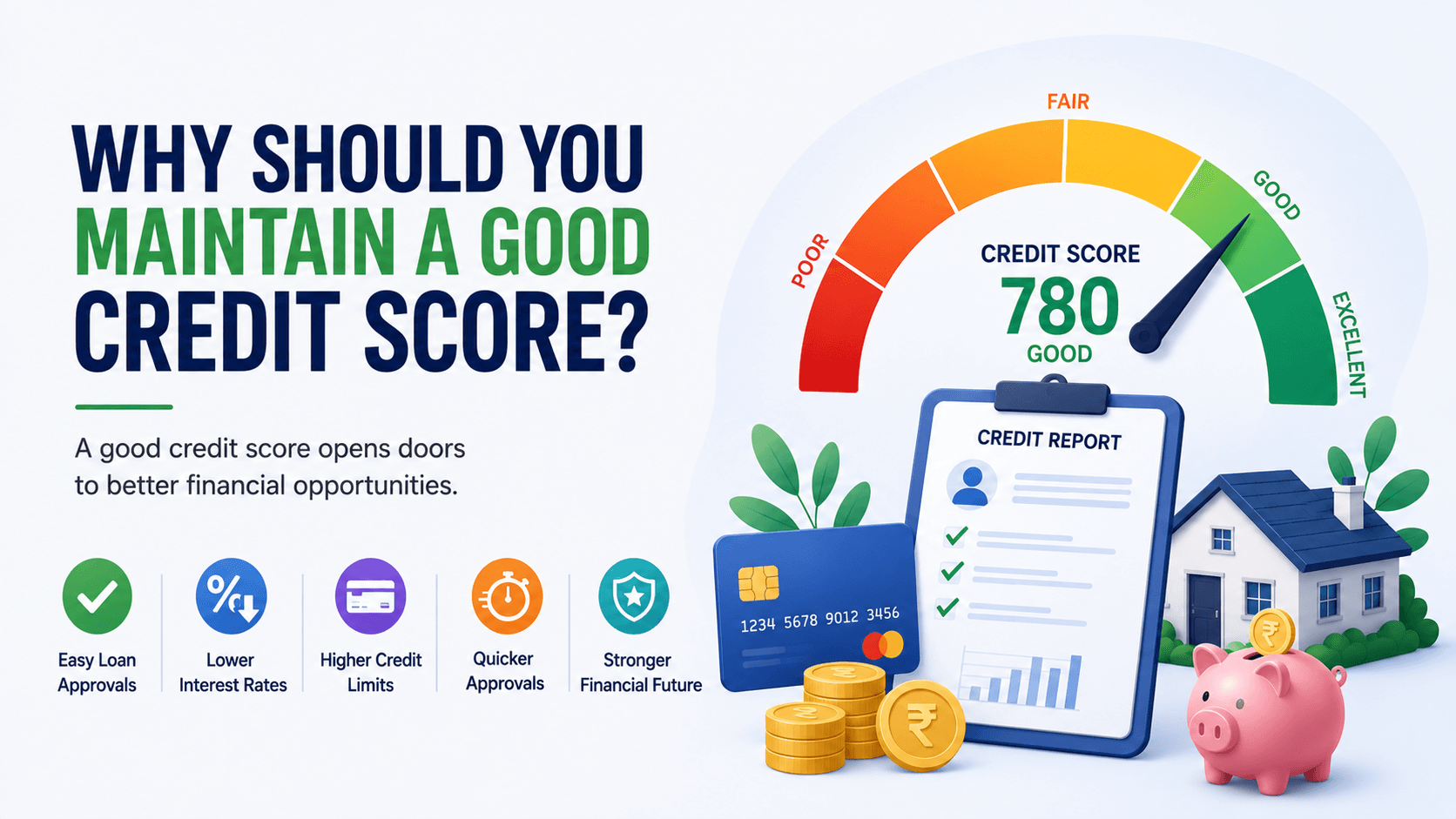
A credit score ranges from 300 to 900 and summarises your credit history. Lenders use it to assess how you have managed borrowed money and whether your repayment behaviour indicates a higher or lower credit risk.
A score of 750 or above is often considered a favourable starting point for a home loan application. However, it is important to distinguish between a score that lenders generally prefer and a mandatory eligibility requirement.
For example, ICICI Bank states that a score of 750 or above is favourable for its home loans, while applicants with scores between 650 and 700 may also be considered subject to additional conditions. Other lenders may follow different criteria.
Therefore, the credit score required for a home loan depends on the lender's individual assessment and lending policy. A higher score can strengthen your application, but it does not automatically guarantee approval.
How Does Your CIBIL Score Affect Home Loan Eligibility?
Your CIBIL score can give lenders an indication of your credit history and repayment behaviour. While there is no universal score classification followed by every lender, the following ranges provide a general idea of how your score may be viewed:
750-900: Strong Credit Profile
A score in this range generally indicates a strong credit profile and may support a more favourable assessment of your credit history.
700-749: Good Credit Profile
This is generally considered a good credit range. You may have a positive starting point for a home loan application, although other eligibility requirements still apply.
650-699: Moderate Credit Profile
A score in this range may lead the lender to examine your repayment history and other financial details more closely.
Below 650: Lower Credit Score
A score below 650 may make a home loan application more challenging with some lenders. Reviewing your credit profile and addressing any outstanding issues before applying may be beneficial.
Remember:
These ranges are indicative, not universal lending categories. Different lenders have different eligibility criteria, and your CIBIL score is only one factor considered during a home loan assessment.
The practical question is not simply whether your score falls within a particular range. It is whether your overall financial profile meets the lender's requirements.
Why Your Credit Score Is Not the Only Home Loan Eligibility Factor?
A home loan is a substantial financial commitment, often spread over many years. Lenders therefore assess whether you can manage the proposed repayments alongside your existing expenses and obligations.
Apart from your credit score, important considerations may include:
- Income and employment stability: Your earnings and employment or business history help lenders assess your repayment capacity.
- Existing EMIs: Personal loans, vehicle loans, and other financial commitments affect how much you can reasonably repay each month.
- Loan amount and property value: The amount you want to borrow in relation to the property's value can influence the lender's assessment.
- Repayment history: Missed payments, overdue accounts and other credit-related issues may raise concerns.
- Credit applications: Several recent credit enquiries may indicate that you are seeking additional borrowing.
- Documentation: Incomplete or inconsistent income and identity documents can delay the assessment process.
Consider two applicants with a credit score of 760. One has stable income, manageable EMIs, and a consistent repayment record. The other has substantial existing debt and irregular income.
Although their scores are identical, the lender may assess their applications differently. This illustrates why home loan eligibility depends on more than a single number.
Can You Get a Home Loan With a Credit Score below 700?
Yes, it may be possible, depending on the lender's criteria and the circumstances of your application. However, a lower score can make the process more challenging.
A lender may examine the reasons behind your score, your current repayment capacity, and the rest of your credit history. Some lenders may consider additional documentation or other conditions, while others may have stricter eligibility requirements.
Before applying, consider these steps:
- Review your credit report. Check for missed payments, outstanding balances, incorrect account details, and unfamiliar credit enquiries.
- Identify the reason for your score. A genuine repayment problem requires a different response from an inaccurate entry on your report.
- Assess your existing commitments. Understand your current EMIs and whether the proposed home loan would be affordable.
- Compare lender requirements. Review eligibility criteria before submitting applications rather than applying indiscriminately.
- Address outstanding issues. Bring overdue accounts up to date where possible and maintain consistent repayments.
Avoid assuming that paying an outstanding amount will immediately increase your score or guarantee loan approval. Credit reporting updates and score changes depend on several factors.
When Should You Check Your Credit Score Before Applying?
Ideally, review your credit score and credit report before you begin submitting home loan applications. This gives you time to identify potential problems rather than discovering them during the lender's assessment.
Pay particular attention to three areas.
- First, check the accuracy of your report. Confirm that the listed accounts and repayment details are correct. If you find an error, raise a dispute through the relevant credit bureau and follow up with the reporting lender where necessary.
- Second, review your repayment behaviour. Check whether any overdue amounts, missed payments, or outstanding balances need attention. If the information is accurate, focus on addressing the underlying issue rather than attempting to remove valid negative entries.
- Third, avoid unnecessary credit applications. Multiple applications in a short period can lead to several credit enquiries. Make informed borrowing decisions and apply when you understand the lender's requirements.
Checking your report does not guarantee a particular score or loan outcome, but it helps you make better-informed decisions before taking on a long-term financial commitment.
Key Takeaways
- A credit score of 750 or above is generally favourable for a home loan, but there is no universal minimum applicable to every lender.
- Your income, existing EMIs, repayment history, and other eligibility criteria also influence the lender's decision.
- Applicants with scores below 700 may still be considered, depending on the lender's policies and individual circumstances.
- Reviewing your credit report before applying gives you an opportunity to identify inaccuracies and address genuine repayment issues.
Check Your FREE Credit Score Here
Frequently Asked Questions
- What is the minimum credit score for a home loan?
There is no single minimum score across all lenders. A score of 750 or above is generally favourable, but individual lenders set their own eligibility criteria.
- Can I get a home loan with a credit score of 650?
It may be possible, depending on the lender's policy, your income, repayment capacity and overall credit profile. Approval is not guaranteed, and some lenders may have stricter requirements.
- Does a higher credit score guarantee home loan approval?
No. A higher score can strengthen your application, but lenders also assess income, existing financial commitments, documentation, and other eligibility requirements.
- How can I improve my credit score before applying for a home loan?
Pay your EMIs and credit card dues on time, manage credit utilisation, avoid unnecessary credit applications, and review your report for errors. Improvements are not guaranteed within a fixed period.
- Can I apply for a home loan if I do not have a credit score?
You may be able to apply, but lenders differ in how they assess applicants without an established credit history. They may consider other financial information or have specific eligibility requirements.
Frequently Asked Questions
CIBIL is a repository of information that collects and maintains the data provided by Banks and NBFCs, where individual have or had loans in the past. It has information about individual past and present repayment history and the status of individual loan accounts, personal information such as individual identity information, employment history, contact information, etc. It also keeps track of all the enquiries that individual has made for credit from various banks and financial institutions.
Get your credit fixed. Open doors to better
loans, cards, and rates.
Loan rejection, low score, no credit history or starting a new business we find what's wrong and fix it.